The engineer's
Delivery Playbook
Beta
A living technology delivery runbook turning your team into seasoned experts, delivering reliably the first time and every time. With activity guides, workshops, templates right at your fingertips.
The checklist every engineer needs
Pilots rely on checklists. For every flight, every aircraft, every weather. It's what keeps the plane in the air when the pilot is tired, distracted or wrong about what's happening. Engineers need one too. That's why I wrote the Delivery Playbook.
Open it when you're stuck. When you're planning. When you're not sure what the next move is. It tells you the inputs, the moves and the outputs — so the team in front of you can run the activity with the rigor of a seasoned practitioner, whether they've done it before or not.
The Delivery Playbook is your runbook while Customer Obsessed Engineering is your community, exploring ideas at length — arguments, case studies, stories — where the playbook is lean, prescriptive and ready at your desk. A checklist, not an autobiography. A living toolkit with guides, workshops, templates and an easy to follow map.
Five working tools, in one delivery system
Each tool closes a gap that costs teams real time, real money or real trust. Together they embed quality without anyone having to police it.
The subway map
The full delivery lifecycle as a connected sequence of activities. One glance tells the whole team where you are, what comes next, and what you've skipped.
The delivery topics
Every subway-map activity gets a dedicated chapter — goals and impact, inputs, activities, outputs, methods, examples and tools. The depth that turns senior-level expertise into something any team can execute.
The guides
Short, structured, focused on how to run it — not theory. Fishbone, pre-mortems, dot voting, 5 Whys, A3, Pareto, TRIZ, SWOT, 1-2-4-All and more. The moves that separate teams who self-correct from teams who spin.
The templates
Real, battle-tested starting points for architecture umbrellas, product visions, feature specs, risk logs, stakeholder maps and more. Each one carries an enormous amount of tacit knowledge — copy, adapt, ship.
The structure
Every piece follows the same pattern: clear inputs, a defined activity, explicit outputs. The structure is the quality gate — projects that follow it don't drift, don't surprise the customer and don't arrive at launch missing a critical deliverable.
Workshops that turn diagnosis into action
Every workshop produces action-items with named owners, expected recovery and a review date. Actions track back to the same waste walk data the workshop started with, and progress is measured over time.
Waste walk
Track team activities to discover what's draining time and effort away — and recapture it by prioritizing and focusing on the 20% of activities that drive 80% of the outcomes.
GembaKai readout
The gateway session after an iteration of activity logging. Walk the team through the readout, frame the productivity opportunity, pick the next workshop from the data — go after the 80%.
Rework workshop
Trace rework hours back to their origin. Almost always the highest-leverage starting point — rework upstream turns into everything else downstream.
Automation workshop
Surface the manual work the team has normalized. Five automation domains, cost × frequency × people, ROI matrix with a Theory of Constraints overlay.
Planning workshop
Find meeting overhead, late decisions and external dependency friction. The hardest of the four because planning waste is diffuse — a hundred small things rather than one big one.
Event storming
A sticky-note-driven design workshop that puts engineers, customers and subject-matter experts around a shared wall to map business events end-to-end — exposing decision points, handoffs and hotspots in half a day.
Integrated and effective
The Delivery Playbook leans heavily on continuous improvement. Incremental rapid delivery, tightly integrated feedback loops, and shift-left policy is grounded in practical, every-day actions like the GembaKai waste walk tool — a guided activity that focuses the team on the highest value activities.
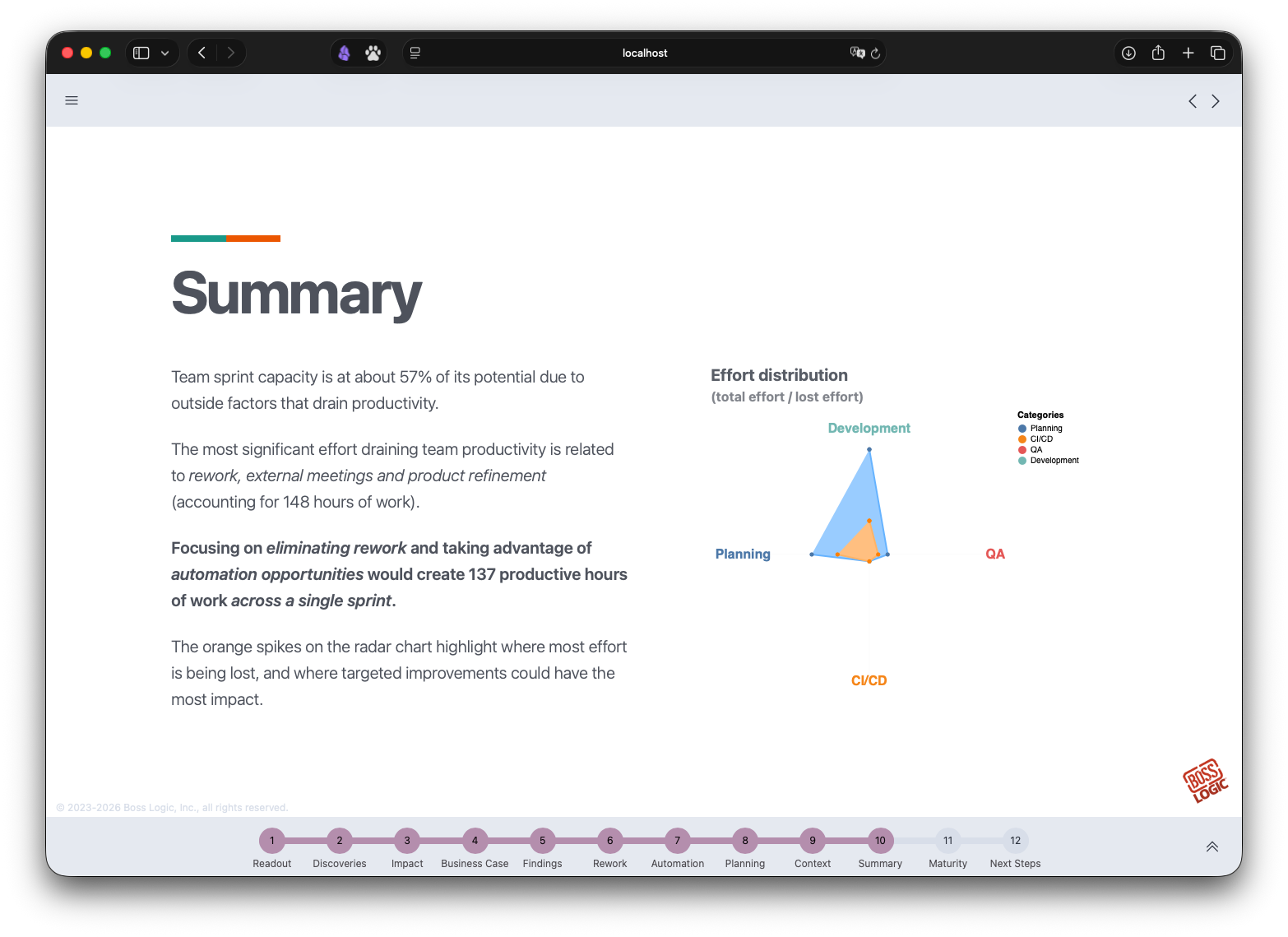
- CaptureTeams capture effort by activity in the Waste Walk app — pinpointing what drains time and energy.
- MeasureFacilitated workshops direct focus where it's needed — driving forward momentum.
- ImproveProgress is tracked. The number moves, or you learn something new, accelerating team velocity.